| In fire experiments conducted in uniformly furnished, but vacant Chicago-area townhouses, National Institute of Standards and Technology (NIST) researchers uncovered temperature and heat-flow conditions that can seriously damage facepiece lenses on standard firefighter breathing equipment, a potential contributing factor for first-responder fatalities and injuries.
The findings are detailed in a report* from a research study sponsored by the U.S. Fire Administration and Department of Homeland Security. The work is an important step toward improving what may be the most vulnerable component of a firefighter's protective gear in high-heat conditions: the facepiece lenses of the so-called self-contained breathing apparatus, or SCBA.
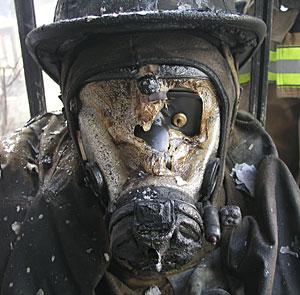
Failure of the lens can expose a firefighter to toxic gases and can result in burns to the respiratory tract as well as asphyxiation. In several SCBA-related deaths, degraded masks were found affixed to the faces of victims while their equipment continued to supply air.
In two of four realistic living-room fire scenarios tested by NIST, "lenses exhibited bubbling and loss of visual acuity, as well as severe deformation, and, in one case, a hole," the NIST team says.
The researchers tested five models of SCBA facepieces, each from a different manufacturer. In all cases of lens degradation, the damage was due to temperatures and heat fluxes that exceeded performance limits of polycarbonate, the lens material commonly used in SCBA for fire fighters.
"Our results do not suggest, in any way, that that lens failures are due to the manufacturers," explains NIST's Nelson Bryner, a co-author of the report. "All the lenses tested were consistent with requirements specified in standards."
In the United States, SCBA makers must submit their products for certification testing before they can be sold. Certification requires passing the "heat and flame test" specified in a standard by the National Fire Protection Association. Citing the conclusions of other researchers, the NIST team notes that this test is conducted at high temperatures, but "it does not capture the conditions of temperature, heat flux and duration that a firefighter might experience."
The townhouse fire experiments will inform efforts to improve the match between standard requirements and real-life conditions. Until now, these efforts have been hampered by lack of information regarding the high-temperature and high-heat-flow performance of polycarbonate lenses and the actual fire-scene conditions that have resulted in lens failures.
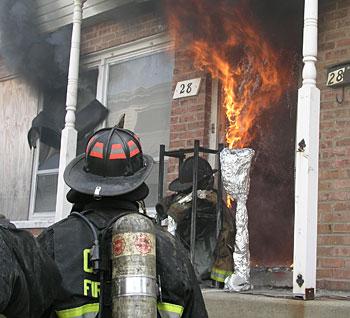
The NIST experiments were conducted in two-story townhouses in Bensenville, a suburb northwest of Chicago, in cooperation with the Bensenville and Chicago Fire Departments and the Bureau of Alcohol, Tobacco and Firearms. In each of the four "furnished-house experiments," the conditions were nearly identical, save for the location of polyurethane heads outfitted with a SCBA facepiece and controlled variations in fire exposure conditions, adjusted, for example, by opening and closing of doors and windows at specified times.
Rooms were equipped with devices to record temperatures rapidly at regular intervals between ceiling and floor. Facepieces also were equipped with sensors, on the inside and the outside of the lenses and in the immediately surrounding space. A gauge to measure heat flow, or flux, was positioned next to the facepieces.
The most devastating damage occurred in a scenario akin to one in which a firefighter would enter a burning living room from a front porch. The living room fire smoldered for five minutes after ignition. Opening the front door literally breathed life into the smoldering fire. The rush of heat from the now blazing living room transformed a relatively cool environment on the porch into an inferno. The SCBA lens's exterior surface temperature reached 280 degrees Celsius (536 degrees Fahrenheit), about the midpoint of the range of published polycarbonate melt temperatures. The lens developed a significant hole, according to the NIST report.
"The next step," the NIST researchers write, "is to identify the exposure limit just before thermal degradation occurs. Data on the limits of the equipment would be valuable information for the fire service to help prevent further injuries and fatalities related to SCBA equipment failure."
* A Mensch, G Braga and N Bryner, Fire Exposures of Fire Fighter Self-Contained Breathing Apparatus Facepiece Lenses. NIST Technical Note 1724, Nov. 2011. The report can be accessed at www.nist.gov/manuscript-publication-search.cfm?pub_id=909917. |