| As summer activities bring more families to backyard pools, community pools, splash parks, lakes, rivers, beaches, and other public swimming areas, fire and EMS officials are reminding parents and caregivers that water safety requires constant attention. Drowning can happen quickly and quietly, often in just seconds, and it can occur even when adults are nearby.
Young children are especially vulnerable around water. Pools, spas, ponds, retention areas, creeks, rivers, lakes, and beaches all present different hazards, but the most important safety practice remains the same: children should always be actively supervised by a responsible adult whenever they are in or near water.
Many drowning incidents happen in familiar places, including backyard pools, apartment or neighborhood pools, hotels, family gatherings, and public swimming areas. These incidents often occur when a child briefly slips away, enters the water unnoticed, or is assumed to be under someone else’s supervision. |
Backyard and Residential Pool Safety
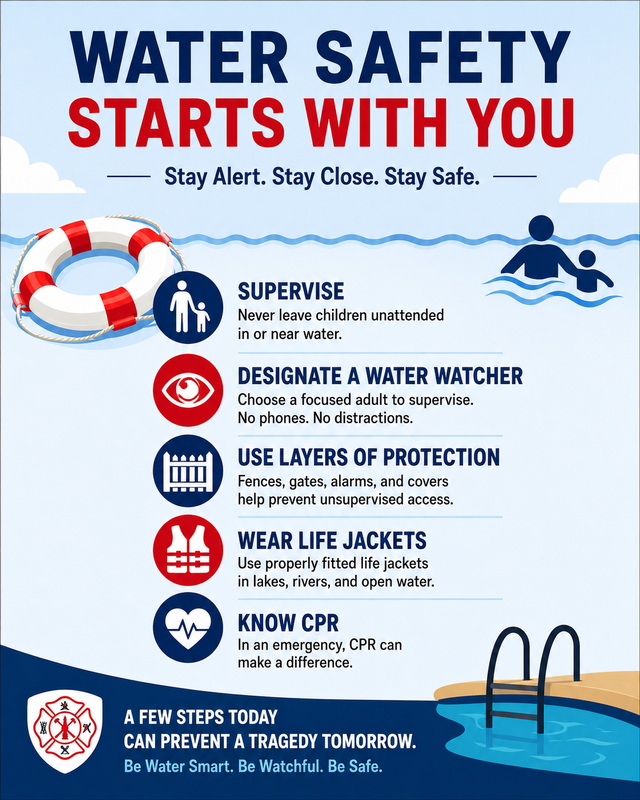
Families with pools at home should use multiple layers of protection to help prevent unsupervised access. A secure fence with a self-closing, self-latching gate is one of the most important safeguards. Doors leading from the home to the pool area should be secured, and families should consider using door alarms, pool alarms, and approved pool covers when the pool is not in use.
Above-ground pools also require special attention. Ladders and steps should be removed, locked, or made inaccessible when swimming is finished. Children can climb quickly, especially when toys, chairs, coolers, or other objects are left near the pool and used as footholds.
Pool owners should also keep the pool area clear of toys, floats, and other items that may attract young children toward the water. When the pool is not being used, remove anything that could draw a child’s attention or give them a way to climb into the pool area.
Proper maintenance is another important part of pool safety. Pool gates, latches, alarms, lighting, drain covers, ladders, handrails, and walking surfaces should be checked regularly. Broken gates, loose drain covers, slippery surfaces, and unsecured equipment should be repaired before the pool is used.
Community, Hotel, and Public Pool Safety
Public pools, hotel pools, and neighborhood pools may have lifeguards, posted rules, and safety equipment, but parents and caregivers should never rely on those safeguards alone. Lifeguards are responsible for watching many people at once and may also be responding to other situations. A parent or caregiver should always provide direct supervision for children in their care.
Before entering a public pool, families should take a moment to identify the shallow and deep ends, locate lifeguard stations, review posted rules, and point out emergency equipment. Children should be reminded not to run on pool decks, push others into the water, dive in shallow areas, or swim beyond their ability.
At public pools, younger children and weak swimmers should remain within arm’s reach of an adult. Life jackets approved for water safety may provide added protection for inexperienced swimmers, but inflatable toys, arm floaties, and pool noodles should not be treated as safety devices.
Families should also be mindful of crowded pool conditions. During busy swim periods, it can be harder to see a child beneath the surface or recognize when someone is in distress. Drowning does not usually look like it does in movies. A child may not be able to call out, wave, or splash. They may simply slip below the surface without drawing attention.
Lakes, Rivers, Beaches, and Other Public Water Areas
Open water presents additional risks that are not always visible from shore. Unlike pools, natural bodies of water may have changing depths, drop-offs, currents, waves, underwater debris, rocks, boat traffic, cold water, and limited visibility. Conditions can change quickly, even in areas that appear calm.
Children and inexperienced swimmers should wear properly fitted life jackets when near or in lakes, rivers, ponds, and other open water. Life jackets are especially important around docks, boats, kayaks, paddleboards, and areas where the water depth is unknown.
Families should swim only in designated areas when available and obey posted warning signs, flags, and instructions from lifeguards or park officials. Avoid swimming near storm drains, spillways, dams, boat ramps, marinas, or fast-moving water. After heavy rain, creeks and rivers may become deeper, faster, and more dangerous than they appear.
At beaches and waterfront parks, parents should watch for rip currents, sudden changes in weather, and children drifting away from their group. Children should be taught to stay where adults can see them and to come out of the water immediately if conditions change.
The Importance of a Water Watcher
Whether at a backyard pool, a hotel, a public swimming area, or a lake, families should designate a responsible adult as the Water Watcher. This person’s only job is to watch the water and the children in or near it.
The Water Watcher should not be using a phone, reading, preparing food, drinking alcohol, socializing away from the water, or handling other tasks. During gatherings, adults should take turns so supervision remains focused. A simple verbal agreement, such as “I am watching the water now,” can prevent confusion about who is responsible.
When swimming is over, supervision should continue until children are away from the water and pool gates, doors, or access points are secured. Many incidents happen after swimming has ended, when adults believe the risk has passed.
Emergency Preparedness
Families should have an emergency plan before they swim. Adults should know the exact location of the pool or water area, especially at parks, campgrounds, apartment complexes, or vacation rentals, so they can quickly provide that information to 911.
A phone should be nearby in case of emergency, and adults should know where rescue equipment is located. Reaching poles, life rings, and first aid kits should be visible and accessible. Pool owners should keep safety equipment in good condition and make sure guests know where it is.
Learning CPR is strongly encouraged for parents, caregivers, pool owners, coaches, camp staff, and anyone who supervises children near water. CPR started immediately can make a critical difference while emergency responders are on the way.
Safety Reminders for Families
Parents and caregivers can help reduce the risk of drowning by following these safety practices:
- Never leave children unattended in or near water.
- Stay within arm’s reach of young children and weak swimmers.
- Assign a focused adult Water Watcher during all water activities.
- Use fences, gates, alarms, and pool covers to limit unsupervised pool access.
- Remove or secure ladders and steps from above-ground pools when not in use.
- Keep toys, chairs, and climbable objects away from pool fences and pool edges.
- Teach children to ask permission before entering or approaching water.
- Use properly fitted life jackets around open water and boats.
- Avoid relying on inflatable toys or floaties as safety equipment.
- Review pool rules and open-water hazards before swimming.
- Learn CPR and call 911 immediately in an emergency.
“Water safety is everyone’s responsibility,” department officials said. “Whether families are swimming at home, visiting a public pool, or enjoying a day at the lake, active supervision and layers of protection are the best ways to prevent emergencies.”
As summer continues, families are encouraged to inspect pool barriers, review water safety rules with children, and make sure every outing near water includes a designated Water Watcher. A few simple precautions can help keep summer activities safe and enjoyable for everyone.
|